
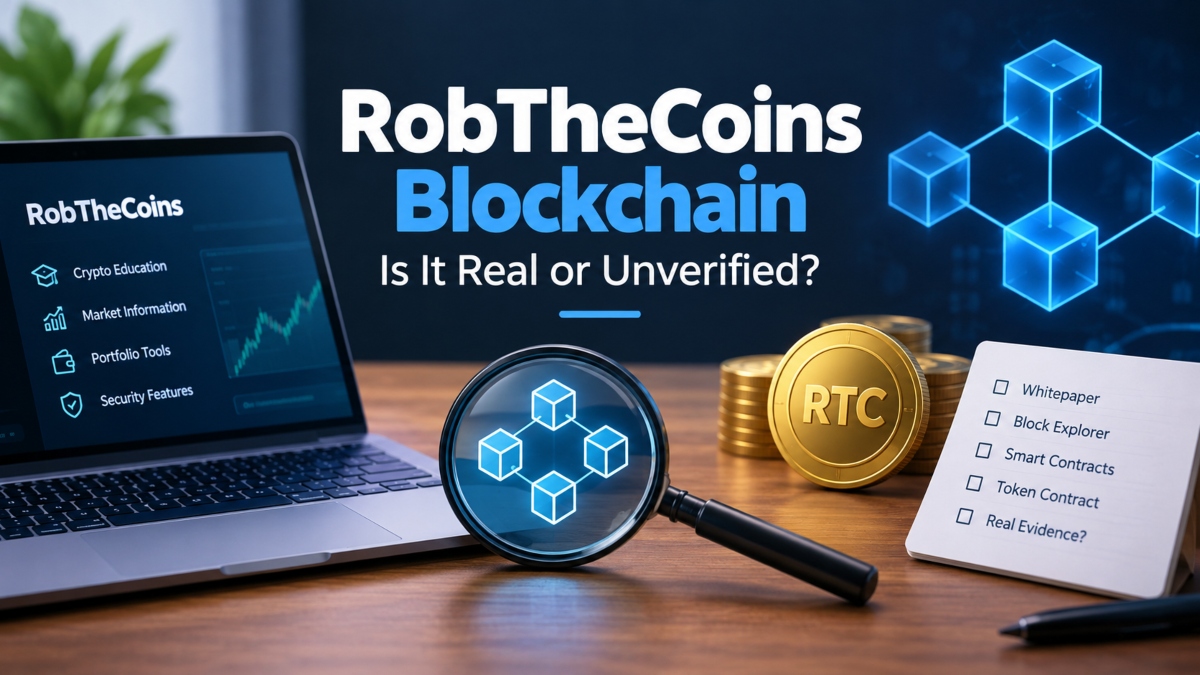
The term RobTheCoins blockchain has caught the attention of people who want to learn more about crypto platforms, digital assets, and emerging blockchain projects. Some online articles associate RobTheCoins with crypto education, portfolio tools, a native RTC token, and smart contract features. But there is a key question behind these claims: does RobTheCoins operate its own independent blockchain?
Based on the available research, there is not enough public evidence to confirm that it does. The information reviewed does not clearly establish a dedicated network, a public block explorer, a verified RTC token contract, or open source code that proves the existence of an independent blockchain.
This does not automatically mean the project is fake. It means readers should separate claims from verified facts before trusting the platform with their money or digital assets.
In this guide, we will look at what RobTheCoins blockchain means, what is known about its reported features, how to check the RTC token claims, and what readers should verify before connecting a crypto wallet or making a purchase.
What Is RobTheCoins Blockchain?
RobTheCoins blockchain is a term used in online content related to the RobTheCoins name. However, descriptions of the platform vary. Some sources present it as a crypto education website, while others associate it with market information, portfolio tools, digital asset services, and a claimed blockchain network.
This variation can make it difficult for readers to understand exactly what the platform offers.
The most careful way to describe RobTheCoins is as a crypto related platform or content ecosystem whose reported features need direct verification. Its status as an independent blockchain network has not been established by the evidence reviewed.
Understanding the RobTheCoins Platform
A crypto platform can offer several services without operating its own blockchain. For example, a website might publish cryptocurrency guides, explain market trends, provide portfolio tracking tools, or help users follow digital assets.
These services can be useful, but they are different from running a blockchain network.
The available research describes RobTheCoins in connection with crypto education and digital asset information. Some sources also mention portfolio and account security features. However, individual features should be checked directly rather than assumed to exist simply because they appear in an article.
For readers, the main distinction is simple: a website that discusses cryptocurrency is not necessarily a cryptocurrency exchange, and a crypto service is not automatically a blockchain developer.
Why Is RobTheCoins Described as a Blockchain?
Some online descriptions associate RobTheCoins with its own blockchain, an RTC token, smart contracts, and decentralized finance features.
These terms sound familiar to anyone who follows crypto news. They are also easy to use in promotional content, which is why readers should look beyond the wording.
A genuine blockchain network normally leaves technical records that others can inspect. These may include a public explorer, network identifiers, transaction histories, technical documentation, and information about how the network reaches agreement on transactions.
The available research does not clearly establish these details for RobTheCoins. Until such evidence can be checked, claims about its independent network should remain unconfirmed.
Platform, Token, and Blockchain Are Different Things
Understanding these three terms makes it easier to assess the RobTheCoins claims.
A platform is a website or service that offers information, tools, or digital products.
A token is a digital asset that exists on a blockchain. It may represent a utility, a governance right, or another type of digital value, depending on its design.
A blockchain is a shared digital ledger that records transactions according to a defined protocol. Its records are maintained and checked by participating computers or network nodes.
A platform can issue a token on an existing network without creating a new blockchain. This distinction matters when evaluating claims about RobTheCoins and its reported RTC token.
Is RobTheCoins a Real Blockchain?
Based on the available research, RobTheCoins has not been established as a verified, independent blockchain network. The information reviewed does not clearly show the technical records needed to confirm that it operates a separate network.
The main issue is not whether a website uses blockchain terminology. It is whether the claims can be checked against public technical evidence.
What Does the Available Evidence Show?
The research identifies several missing or unclear details:
- A public block explorer for a dedicated RobTheCoins network
- A confirmed chain ID or other network identifier
- Technical documentation explaining the network’s design
- Public source code that establishes how the blockchain works
- Clear information about validators, nodes, or its consensus mechanism
- A verified contract address for the reported RTC token
These details matter because they allow people outside a project to examine how its technology works.
For example, if a project claims to process blockchain transactions, readers should be able to find records of those transactions through a relevant explorer. If it claims to offer a token, there should be a way to identify the correct contract and network.
The absence of clear evidence in the sources reviewed does not prove that no technical infrastructure exists. It means the claims cannot currently be treated as confirmed facts on the basis of that research.
Which RobTheCoins Features Remain Unverified?
The available information leaves several claims open to question.
The existence of an independent blockchain has not been established. The reported RTC token also lacks clear public confirmation through a verified contract address and recognized market records in the research provided.
Claims about smart contracts and decentralized finance features need similar checks. A project description may explain what a service is supposed to do, but it does not prove that the service has been built, deployed, or made available to users.
Readers should also distinguish between a feature that has been announced and one that is working and independently verifiable.
Does Missing Documentation Mean RobTheCoins Is Fake?
No. Missing documentation alone is not enough to prove that a project is fraudulent.
A project might have limited public records, incomplete documentation, or information that is difficult to locate. At the same time, people should not treat unverified claims as proof that a project is genuine.
The fairest assessment is that RobTheCoins’ independent blockchain status remains unverified based on the available research.
That conclusion may change if reliable technical evidence becomes available. Until then, readers should be cautious about claims involving a native network, token value, smart contract features, or investment opportunities.
RobTheCoins RTC Token: What Should You Know?
The RTC token is another part of the RobTheCoins discussion. Some online sources describe RTC as a native token connected to the platform, but the available research does not confirm a verified token contract or a recognized market listing.
That leaves an important question for anyone considering buying it: how can you identify the actual asset and check whether it is safe to use?
Is RTC a Confirmed Native Token?
A token symbol by itself is not enough to establish the identity of a cryptocurrency. Different projects can use the same symbol, and a token can exist on an established blockchain without having its own network.
To verify the RTC claim, readers need a contract address, the name of the network on which the token operates, and records that can be checked independently.
The research provided does not establish these details for the RTC token associated with RobTheCoins. As a result, it would be premature to describe RTC as a confirmed native cryptocurrency.
How Can You Check a Token Contract?
Before buying an unfamiliar token, take a few minutes to check its technical records.
First, find the contract address through a reliable official source. Then confirm that the address belongs to the correct project and network. Search for the contract on the relevant blockchain explorer and examine the available transaction history, token supply, and holder information.
Next, check whether the token has meaningful trading activity and available liquidity. A token name appearing on a trading website does not necessarily mean it has a healthy market or that you can sell it easily.
You should also look for independent security reviews where relevant. An audit can help identify certain weaknesses, but it cannot remove every risk associated with a token.
What Should You Check Before Buying RTC?
Do not rely on promotional claims, screenshots, or promises about future prices. Confirm the token’s identity, network, liquidity, ownership details, and any available security reports.
If these details cannot be verified, the safer choice is to avoid sending money until the uncertainty has been resolved.
RobTheCoins Blockchain Claims vs. Verifiable Evidence
When researching a crypto project, it helps to compare what it claims with the records available to support those claims. This approach keeps the discussion factual and makes it easier to spot missing information.
The following table summarizes the RobTheCoins claims covered in the available research.
| Claim | Evidence to look for | Current assessment |
|---|---|---|
| RobTheCoins operates its own blockchain | Public explorer, network identifier, technical documents | Not verified |
| RobTheCoins has an RTC token | Confirmed contract address and network records | Not verified |
| The network supports smart contracts | Public code and deployed contract records | Not verified |
| The platform offers crypto education | Accessible content and platform information | Reported by third party sources |
| The platform offers portfolio tools | Working features and clear documentation | Requires direct confirmation |
| RobTheCoins supports DeFi services | Deployed protocols and verifiable transactions | Not verified |
How Should You Read These Findings?
The table does not suggest that every RobTheCoins related claim is false. Instead, it shows that different claims need different kinds of evidence.
For example, a website can publish useful cryptocurrency guides without operating a blockchain. Similarly, a token might exist on another network without proving that its associated brand has created a separate blockchain.
Repeated claims across several websites should not be treated as independent confirmation if those websites rely on one another or repeat the same unsupported information.
The best evidence comes from records that can be examined directly, such as technical documentation, public transaction histories, verified contract addresses, and accessible source code.
How Would a Real Blockchain Work?
Understanding the basics of blockchain technology can help readers assess claims about RobTheCoins without needing an advanced technical background.
A blockchain records transactions in groups called blocks. These blocks are connected through cryptographic hashes, which help protect the integrity of the transaction history. Network participants use a defined protocol to check transactions and maintain agreement about the ledger.
Blocks, Transactions, and Cryptographic Hashes
Imagine sending cryptocurrency to another wallet. The network receives the transaction, checks whether it meets the protocol’s rules, and records it through the blockchain’s transaction process.
A block contains transaction data and other information required by the network. Cryptographic hashes help connect blocks and make changes to previously recorded data easier to detect.
The exact design differs between blockchain networks, so these general features should not be taken as proof that a particular project uses a specific technical system.
Nodes and Consensus Mechanisms
Nodes are computers that participate in maintaining or checking blockchain data. Depending on the network, some nodes may also take part in confirming transactions or producing new blocks.
A consensus mechanism defines how the network agrees on valid records. Proof of Work and Proof of Stake are two widely known approaches, although other methods also exist.
If RobTheCoins operates an independent blockchain, its documentation should explain how its network reaches agreement, how participants join, and how transactions are confirmed. The available research does not establish these technical details.
How Can Public Blockchain Data Be Checked?
Public blockchain explorers let users inspect transactions, wallet addresses, block records, and other network information. A chain ID or equivalent network identifier can help distinguish one network from another.
Public source code can also help developers assess how a blockchain is designed. However, publishing code alone does not prove that a live network is operating.
For RobTheCoins, these are the kinds of records readers should look for before accepting claims about its blockchain infrastructure.
How to Verify RobTheCoins Before Trusting It
A little research can help prevent costly mistakes when dealing with unfamiliar crypto platforms. Before depositing funds, buying RTC, or connecting a wallet, work through the following checks.
Check the Official Whitepaper and Technical Documents
A whitepaper should explain what a project is building, how its technology works, and what purpose its token serves. For a blockchain project, look for information about its architecture, transaction process, consensus rules, fees, and network participants.
Check whether the documents identify the development team and provide enough technical detail for independent review.
Be cautious if the available material relies mainly on broad promises without explaining how the system works. For RobTheCoins, the research reviewed does not establish a clearly verifiable technical document that confirms an independent blockchain.
Find the Block Explorer and Network Identifier
A public explorer can provide useful evidence that a blockchain network is processing transactions. Look for block records, transaction histories, wallet activity, and the network identifier.
Check whether the explorer is connected to the project through reliable documentation. A page that displays blockchain data is not enough on its own to establish that the network belongs to RobTheCoins.
If no explorer or network identifier can be confirmed, the claim of an independent blockchain remains unresolved.
Review Source Code and Smart Contract Audits
A public code repository can allow developers to inspect the network’s design, examine changes, and review its implementation. For token or smart contract claims, look for deployed contracts that match the documented addresses.
Security audits can offer another layer of information. Read what was reviewed, which contract version was tested, what issues were found, and whether those issues were fixed.
An audit does not guarantee that a project is safe, and a code repository does not prove that a live network exists. Each piece of evidence should be considered in context.
Check Token Listings, Liquidity, and Legal Details
If a project claims that its token trades on a cryptocurrency exchange, verify the asset’s identity and trading records. Review liquidity, trading activity, withdrawal conditions, and the risks of buying an asset with limited market access.
You should also check the company or team behind the platform, its published terms, its privacy policy, and any applicable registration or licensing details.
The absence of a listing on a major market does not prove wrongdoing. However, a lack of reliable information can make it harder to assess the token and its risks.
If important details remain unclear, avoid sending funds based on marketing claims alone.
Is RobTheCoins Safe to Use?
The available research does not provide enough evidence to make a definitive judgment about the safety of RobTheCoins. Its reported blockchain and RTC token features remain unverified, so users should be careful about treating the platform as an established blockchain service.
The level of caution should reflect what you intend to do. Reading publicly available educational material carries different risks from depositing cryptocurrency, signing a wallet transaction, or buying an unfamiliar token.
Risks of Unverified Crypto Claims
Unclear project details can make it difficult to identify who operates a service, where funds are held, or how a token works. If a token has little liquidity, selling it later may be difficult. If a wallet interaction grants broad permissions, digital assets may be exposed to additional risk.
Promises of guaranteed returns, pressure to deposit quickly, or requests for sensitive wallet information should be treated as warning signs.
These risks are common across the crypto market. They should not be presented as proven misconduct by RobTheCoins without specific supporting evidence.
Protect Your Wallet and Account
Use unique passwords and multifactor authentication where available. Never share your wallet’s seed phrase or private keys with a website, support agent, or another person.
Before signing a wallet transaction, read the details and check which permissions you are granting. Do not connect a wallet simply because a website claims to offer rewards, exclusive tokens, or early access.
If you decide to explore an unfamiliar service, start by checking its identity and documentation. Do not use money you cannot afford to lose, and remember that even a small transaction can expose you to risk if you approve an unsafe request.
What Should You Do Before Depositing Funds?
Wait until the important claims can be checked through reliable records. For a claimed blockchain, that means technical documentation and public network evidence. For a token, it means a confirmed contract address, network details, and market information.
If those details are missing, there is no need to rush. An unverified project does not become trustworthy simply because its website looks professional or its claims appear on several other sites.
RobTheCoins Blockchain Review: Final Assessment
The main question surrounding RobTheCoins blockchain is whether it operates a real, independent blockchain network. Based on the available research, that claim remains unverified.
RobTheCoins is described by some sources as a crypto related platform associated with educational content and digital asset tools. However, the reported RTC token, smart contract features, and independent network lack clear public evidence in the material reviewed.
That distinction matters. A crypto website can provide information without running a blockchain, and a token claim does not prove that a separate network exists.
Before buying RTC, depositing funds, or connecting a wallet, check the technical documentation, network records, contract address, and security information. Until reliable evidence supports the claims, treat RobTheCoins’ blockchain status as unconfirmed rather than assuming it is either genuine or fraudulent.
Frequently Asked Questions About RobTheCoins Blockchain
What is RobTheCoins blockchain?
RobTheCoins blockchain is a term used in content associated with the RobTheCoins name. The available research does not establish that it operates an independent blockchain network. Its reported features should be checked against public technical records before being treated as confirmed.
Is RobTheCoins a legitimate blockchain project?
Its independent blockchain status remains unverified based on the research reviewed. Readers should examine technical documents, public network records, and other reliable evidence before deciding whether to trust the platform with funds or digital assets.
Does RobTheCoins have its own cryptocurrency?
Some sources mention an RTC token associated with RobTheCoins. However, the supplied research does not confirm a verified token contract or recognized market listing. Readers should verify the exact asset and its network before considering a purchase.
Is the RobTheCoins RTC token safe to buy?
There is not enough verified information in the supplied research to establish that the RTC token is safe. Check its contract address, network, liquidity, ownership details, and available security reports. Never rely on promotional claims alone when deciding whether to buy a token.
Does RobTheCoins support smart contracts?
The research reviewed does not establish independently verifiable smart contract deployments associated with RobTheCoins. Public contract addresses, deployed code, and relevant technical records would help confirm whether this feature exists.
How can I verify a blockchain project?
Look for a technical whitepaper, public block explorer, network identifier, transaction history, source code, verified token contracts, and independent security reviews. Check the evidence through reliable sources rather than relying only on a project’s own descriptions.
Is RobTheCoins similar to Ethereum or Solana?
The available research does not establish RobTheCoins as a comparable Layer 1 or Layer 2 blockchain network. Ethereum and Solana have publicly accessible network records and established technical ecosystems. A direct comparison would require verifiable evidence of RobTheCoins’ own network and architecture.
Read More: Crew Disquantified Org: Meaning, Team and Workplace Culture