

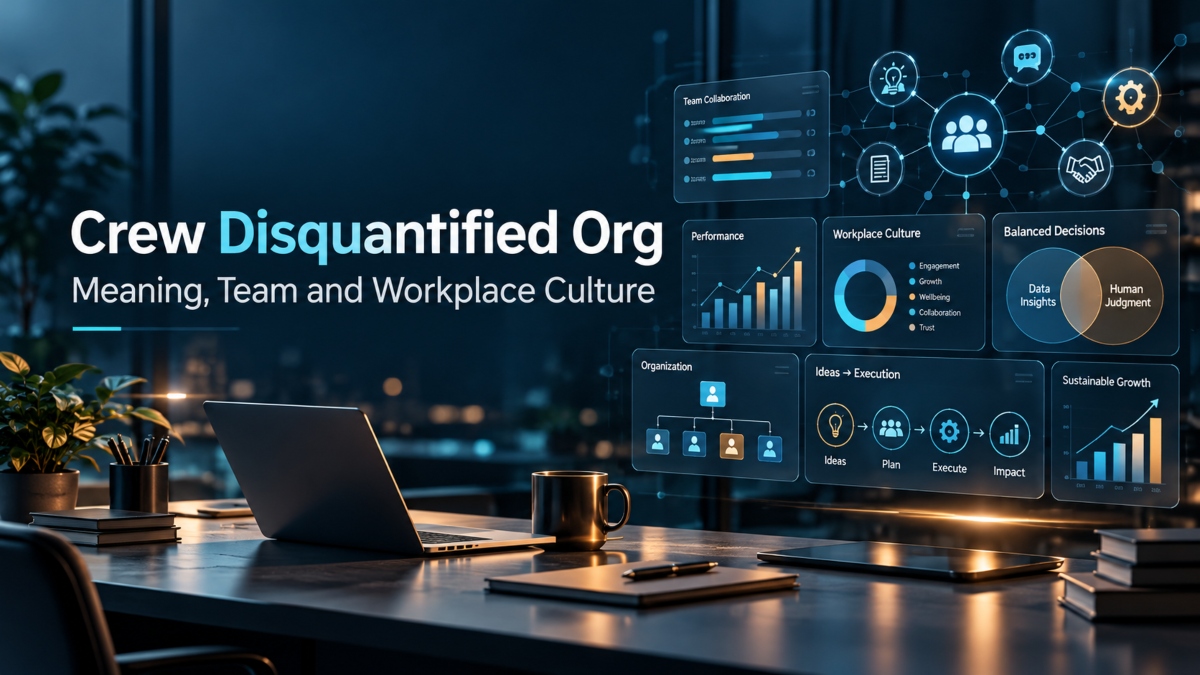
The phrase Crew Disquantified Org can mean two different things, depending on what someone wants to know. Some people use it to find information about the team behind Disquantified.org, while others use it to learn about a workplace approach that values human judgment alongside performance data.
Both interpretations have something in common: they raise questions about how people work together, how information is used, and how teams make decisions.
If you have come across this term and want a straightforward explanation, it helps to separate the website’s team from the broader idea of a people focused workplace. One relates to a specific online project, while the other concerns how organizations manage employees, measure performance, and build trust.
This guide explains the meaning of Crew Disquantified Org, the team’s stated working methods, the ideas behind disquantified management, and practical ways businesses can avoid measuring every task with a number.
What Is Crew Disquantified Org?
Crew Disquantified Org is a search phrase associated with Disquantified.org and with discussions about reducing excessive workplace measurement. It is not a universally established name for a registered company or a formally recognized management system.
The word crew usually refers to a group of people working together. Disquantified suggests moving away from an excessive reliance on numerical measurements. The word org is commonly used as a short form of organization.
Put together, these terms point toward two possible meanings.
The first is the team described by Disquantified.org, which presents its work as collecting, analyzing, and publishing public data. The second is a workplace concept in which teams use performance figures when they help, rather than treating numbers as the only way to judge work.
Understanding this difference matters because the two meanings serve different purposes. Someone looking for the people behind a website needs information about its team and activities. A manager researching a different way to assess employees needs practical guidance on performance, communication, and accountability.
The Meaning Behind the Term
In its workplace context, disquantification is about questioning whether every activity needs a numerical target or score.
Consider a content team. A manager might measure the number of articles published each week, but that figure does not tell the whole story. An article that attracts the right readers, answers their questions, and earns their trust may be more useful than several pieces produced simply to meet a quota.
Numbers still have value. The issue is what happens when a measurement becomes more important than the work itself.
Why People Search for Crew Disquantified Org
People may search for this phrase to find out who runs Disquantified.org, understand its purpose, or learn about its approach to teamwork.
Others may have encountered the term in an article about workplace culture and want to know whether it describes a real company, a management method, or a general idea.
Because the phrase has more than one use, the clearest explanation should cover both interpretations without presenting them as the same thing.
Who Is Behind Disquantified.org?
Disquantified.org describes its crew as a group involved in collecting public data, analyzing records, and turning findings into reports that readers can understand and check.
According to the site’s own description, its work serves journalists, researchers, and members of the public who want access to documented information. It also describes an approach that values transparent methods, supporting records, and clear explanations of how findings are produced.
These details provide an overview of how the website presents its work. They do not, by themselves, confirm the identities, qualifications, or employment status of every person associated with the project.
The Team’s Stated Roles and Responsibilities
The website describes several types of work within its team, including data science, engineering, and communications.
Each area has a different purpose. Data specialists may work with records and statistical methods. Engineers may help manage data pipelines and the systems used to process information. Communications staff may turn technical findings into reports that a general audience can follow.
A project that brings these skills together can connect technical work with clear public communication. Still, readers should distinguish between the roles described on a website and independently confirmed details about named team members.
The Website’s Mission and Public Data Work
The site’s stated focus is to turn public information into reports that people can examine and understand.
Raw records are not always easy to interpret. Information may be spread across different documents, use inconsistent formats, or require context before a reader can draw a fair conclusion.
A clear report should explain where its information came from, how it was processed, and what its findings can and cannot establish. This gives readers a better basis for judging the work rather than asking them to accept a conclusion without explanation.
How Does the Disquantified.org Crew Work?
According to the site’s published account, its workflow covers data collection, analysis, review, and publication. The process is described as a series of steps, with documentation helping readers follow how a report was prepared.
The exact workflow can vary according to the type of data and the question being examined. A small public dataset may need little preparation, while a large collection of records may require cleaning, validation, and careful handling.
Data Collection, Analysis and Reporting
The first step is gathering the information needed for a report. The team then needs to check the records, correct formatting problems where possible, and look for gaps or inconsistencies that could affect the results.
Analysis comes next. Depending on the project, this may involve comparing records, identifying patterns, calculating figures, or preparing visual explanations.
Before publication, the findings should be checked against the available evidence. A figure can be mathematically correct and still give readers the wrong impression if important context is missing.
For this reason, good reporting explains both what the data shows and where its limits begin.
Tools, Documentation and Quality Checks
The website describes the use of tools such as Python, R, PostgreSQL, version control, and data visualization libraries. It also refers to practices such as code review, peer review, and automated checks.
These tools serve different purposes. Programming languages help process and analyze information, databases organize records, and visualization tools help readers interpret results.
Documentation is just as important as the software. A report becomes easier to check when its methods, calculations, references, and known errors are recorded clearly.
The site describes these practices as part of its working process. Readers should treat them as the website’s stated methods unless they have independently checked the underlying records.
Contributors and Community Participation
The website also describes ways for volunteers and other contributors to take part in its projects. These include public issue trackers, contributor guidance, workshops, and other forms of collaboration.
Open participation can help a project receive feedback from people with different skills. Someone with data experience may spot a technical issue, while another contributor may notice that a report is difficult to understand.
Clear contribution rules help keep this work organized. Contributors need to know how to credit information, report problems, protect sensitive records, and communicate disagreements.
What Does Disquantified Org Mean in the Workplace?
In a workplace setting, a disquantified organization is a way of thinking about management that questions excessive reliance on numbers.
Businesses often use key performance indicators, commonly called KPIs, to track sales, output, customer service, and other results. These measurements can help teams understand whether their work is meeting agreed goals.
Problems arise when a company treats every number as a complete picture of performance.
Imagine a customer support team measured only by the number of tickets closed each day. Employees might rush through conversations to improve their scores, even when a customer needs more time and attention. The dashboard could look healthy while the actual service gets worse.
A people focused approach looks at the wider picture. It considers numerical results alongside the quality of work, customer feedback, working conditions, and professional judgment.
Balancing KPIs With Human Judgment
A useful performance review should ask more than whether an employee reached a target.
It should also consider the quality of the result, the difficulty of the task, the resources available, and the needs of the people affected by the work.
For example, a designer may complete fewer projects than a colleague because one assignment involves a major website redesign. Looking only at completed tasks could make the designer appear less productive, even if the final work solves a larger business problem.
Numbers can start the conversation, but they should not replace it.
Managers can make fairer decisions by reviewing work samples, discussing obstacles, gathering feedback, and considering the results each person was expected to deliver.
Does a Disquantified Workplace Eliminate KPIs?
No. Reducing unnecessary measurement does not mean abandoning performance targets, budgets, deadlines, or accountability.
Some measurements are essential. A business needs to understand its costs, monitor product quality, track customer retention, and meet relevant safety or regulatory duties.
The goal is to keep the measurements that support sound decisions and question those that add little value.
A useful test is simple: What decision will this number help us make?
If a metric has no clear purpose, nobody uses it to change an action, and collecting it consumes time, it may be worth reviewing. If it helps a team detect a problem or understand an important result, keeping it makes sense.
Potential Benefits of a Disquantified Workplace
Reducing unnecessary tracking can change how people spend their time and how managers assess their work. The results depend on the organization, the type of work, and the way the approach is introduced.
More Room for Creativity and Focus
Constant reporting can interrupt work that needs concentration. Employees may spend more time updating dashboards than solving the problems those dashboards were created to track.
Removing low value reporting tasks can give people more time to plan, test ideas, and complete demanding work.
For example, a software team may learn more from testing a small product change and reviewing user feedback than from recording a long list of daily activity figures.
The point is not to stop tracking progress. It is to make sure reporting supports the work rather than becoming the work.
Greater Trust and Employee Autonomy
Employees often work better when they understand their goals and have room to decide how to reach them.
A manager can set clear expectations without checking every small action. Regular conversations, agreed deadlines, and reviews of completed work may provide enough information for many roles.
This approach also requires responsibility. Employees need to communicate delays, explain decisions, and raise problems before they grow.
Trust works best when freedom and accountability remain connected.
Better Context for Performance Reviews
A single score can hide important details about someone’s contribution.
Customer feedback, examples of completed work, peer comments, and discussions about difficult assignments can help managers understand performance more accurately.
These forms of evidence also have limits. Personal opinions can be biased, and feedback can vary from one person to another. Qualitative judgment should therefore be supported by clear standards and fair review practices.
Combining different forms of evidence gives managers a broader view than relying on one number alone.
How to Build a Disquantified Organization
Organizations do not need to remove every KPI to make their management practices more balanced. A practical starting point is to review existing measurements and identify which ones genuinely help people make decisions.
Audit Existing Workplace Metrics
Begin by listing the metrics used across the business. Include the person or team responsible for each one, how often it is collected, and what it is meant to measure.
Then ask a few direct questions:
- What decision does this metric support?
- Does anyone use the result to change an action?
- How much time and money does it take to collect?
- Could it encourage behavior that harms quality?
- Does it reveal a problem that another measure would miss?
This review can help managers spot measurements that have remained in place long after their original purpose disappeared.
Keep the Metrics That Matter
Once the audit is complete, retain the figures that help the organization understand its performance and risks.
Depending on the business, these may include customer retention, product defects, operating costs, response times, safety incidents, or service quality.
A small dashboard is often easier to use than a long list of unrelated figures. Each measure should have a clear owner and a defined purpose.
The right number of metrics depends on the work. A hospital, an online store, and a software company will have different needs.
Combine Numbers With Qualitative Feedback
Numerical data can tell a manager what happened, while feedback and examples may help explain why it happened.
A sales team, for instance, might meet its monthly target while receiving repeated complaints about unclear product information. Looking at sales figures alone would miss a problem that could affect future customer relationships.
Managers can review customer comments, speak with employees, examine work samples, and look at the conditions behind the results.
The aim is to use evidence from more than one source without making the review process so heavy that people struggle to complete their work.
Review the System and Set Clear Rules
Metrics need regular review because business goals and working conditions change.
Set a schedule to check whether existing measures remain useful. Give teams a clear process for suggesting new metrics, removing outdated ones, and raising concerns about unfair targets.
Managers should also explain how performance decisions are made. Employees are more likely to trust a system when they understand what is measured, why it matters, and how their work will be assessed.
Challenges and Limitations to Consider
A workplace with fewer metrics can still run into problems. Removing useful measurements without replacing them with clear goals may leave teams unsure about expectations or make it harder to spot risks.
Maintaining Accountability Without Excessive Tracking
Employees need to know what they are responsible for and how their work will be reviewed. Managers can set clear goals, agree on deadlines, and hold regular progress discussions without monitoring every action.
The best method depends on the role. A job involving safety checks may require detailed records, while creative work may call for more flexible reviews.
Choosing When Measurement Is Necessary
Some work requires precise measurement. Financial reporting, workplace safety, legal duties, and product quality may all depend on accurate records.
The challenge is to distinguish useful oversight from tracking that adds little value.
A balanced organization keeps the information needed to protect people, manage resources, and assess results. It questions measurements that create pressure without helping the team do better work.
Is Crew Disquantified Org a Verified Organization?
The phrase Crew Disquantified Org should not automatically be treated as the official name of a registered company or a recognized management framework.
Disquantified.org describes its own team, activities, and working methods. That provides a starting point for understanding how the website presents itself, but a site’s description alone does not confirm its legal status, the identities of its staff, or the independent accuracy of every claim.
Readers who need to assess the project should check its current published information, author details, contact options, documented methods, and supporting records.
It is also worth separating the website’s identity from the workplace concept discussed under a similar name. The latter is best understood as a general management idea unless stronger evidence establishes a formal organization or recognized standard.
Frequently Asked Questions
What Is Crew Disquantified Org?
Crew Disquantified Org is a search phrase associated with the team behind Disquantified.org and with the idea of reducing unnecessary workplace measurement. The meaning depends on whether the reader is looking for website information or a different approach to team management.
Who Runs Disquantified.org?
Disquantified.org describes a team involved in data analysis, engineering, and communications. The site’s own material explains its stated roles and workflow, but readers should seek independent confirmation before relying on specific claims about individual team members or their credentials.
What Does Disquantified Mean in Business?
In business, disquantified refers to an approach that questions excessive reliance on numerical performance measures. It favors using relevant data alongside feedback, work quality, context, and professional judgment.
Does a Disquantified Organization Use KPIs?
Yes. This approach can retain KPIs that support useful decisions, such as customer retention, costs, quality, and safety. It questions measurements that consume time or encourage behavior that conflicts with the organization’s actual goals.
How Can a Team Reduce KPI Overload?
A team can start by listing its current metrics, identifying the decisions each one supports, and removing measures that no longer serve a useful purpose. Regular reviews and clear rules for adding new metrics can help prevent the problem from returning.
Is Crew Disquantified Org an Official Company?
The information discussed here does not establish that Crew Disquantified Org is a registered company or a formally recognized management framework. Anyone who needs confirmation should check relevant official records and distinguish verified details from descriptions published online.
Final Thoughts on Crew Disquantified Org
Crew Disquantified Org has two related but distinct meanings. One concerns the team described by Disquantified.org and its stated work with public data. The other concerns a workplace approach that questions excessive tracking and gives greater weight to context, work quality, and human judgment.
For readers researching the website, checking its published information and supporting records is a sensible starting point. For managers, the practical lesson is to measure what helps the team make better decisions, retain clear accountability, and avoid turning every part of working life into a score.
Read More: Money Disquantified Org: Meaning, Benefits, and Risks