
Online advertising can look simple at first. You choose an audience, create an ad, set a budget, and wait for people to visit your website. The real work begins when you need to know whether those visitors are interested in your offer and whether the money you spend brings any value.
That is where the search for FeedBuzzard advertise comes in. FeedBuzzard’s advertising information describes ways for businesses, publishers, and marketers to promote content through feed placements, banner ads, sponsored articles, and other promotional formats. However, the options described on its related websites are not all the same, and some details need to be checked before making a payment.
In this guide, you will learn what FeedBuzzard advertising means, which ad formats are reported, how to approach a campaign, what costs to ask about, and how to check whether the service suits your business.
What Does FeedBuzzard Advertise Mean?
FeedBuzzard advertise refers to using advertising placements associated with FeedBuzzard to promote a brand, product, service, or piece of content. The general idea is to put a promotional message in front of people while they browse articles, headlines, topic lists, or other website content.
Instead of relying only on social media posts or search engine ads, a business may look at feed based placements to attract visitors to a website or introduce people to a new offer.
For example, imagine you run a software company and have published a useful guide about managing business expenses. A relevant sponsored placement could introduce that guide to readers who are already browsing business related content. Some may click through to read it, while others may leave without taking further action. The actual outcome depends on the audience, ad creative, placement, and landing page.
The key point is that an ad placement can bring visitors, but it does not guarantee sales, leads, or a positive return.
Understanding FeedBuzzard Advertising
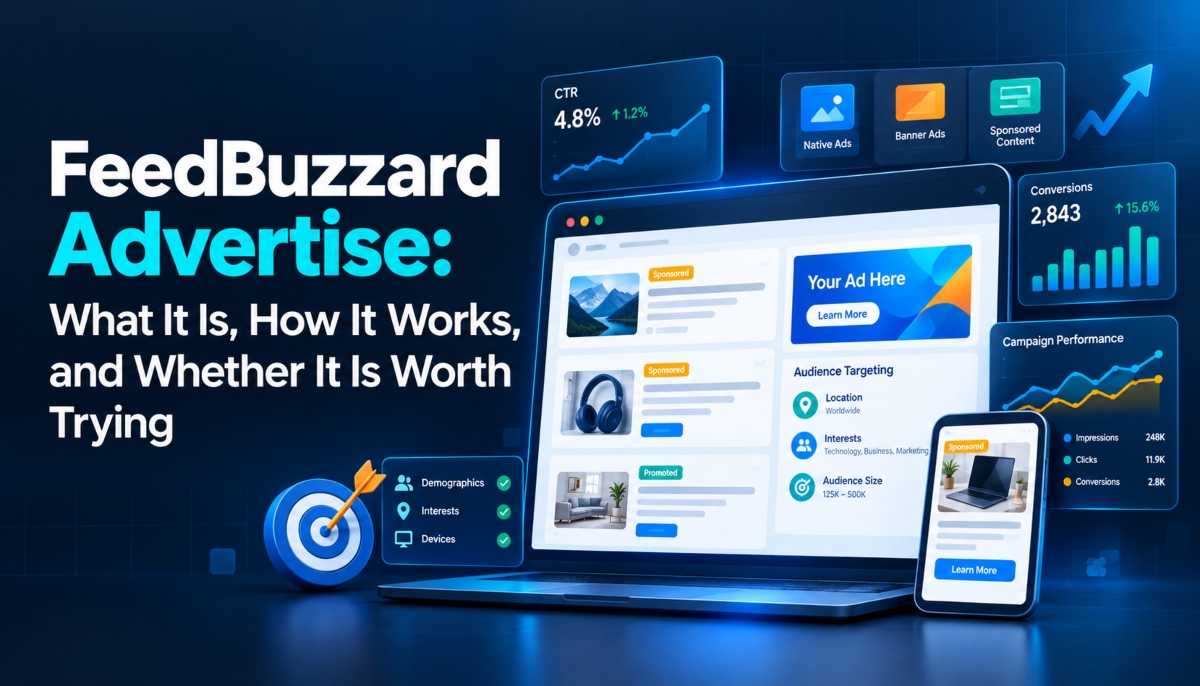
Native advertising is one of the main formats described in FeedBuzzard.com advertising information. These ads are designed to fit within a content feed, often using a headline, image, and short description.
The format can feel less disruptive than a pop up because it appears alongside other content. However, paid promotions should still be clearly identified as advertising so readers can tell the difference between editorial material and sponsored content.
Other reported options include sponsored links and placements between feed items. These formats may suit advertisers who want to promote a specific article, product page, or landing page.
FeedBuzzard.com vs. FeedBuzzard.us
One detail worth checking is that FeedBuzzard.com and FeedBuzzard.us present different advertising information.
FeedBuzzard.com focuses on native feed placements, campaign targeting, creative testing, and performance measurement. FeedBuzzard.us describes a wider range of publisher advertising options, including banners, newsletter promotions, and sponsored articles.
These differences matter when you contact the service. Do not assume that every format, targeting feature, or reporting option is available across both websites.
Before committing money, confirm the exact domain, the advertising package being offered, the placement location, and the terms of the campaign.
Is FeedBuzzard a Self Service Ad Network?
The available public information does not establish that FeedBuzzard operates a conventional self service advertising platform with a fully documented dashboard, public rate card, and independently verified performance data.
This does not automatically mean the service is unsuitable. Some publishers arrange advertising through direct inquiries rather than an automated platform.
Still, advertisers should ask how campaigns are booked, how payments are handled, what reporting is provided, and whether they can review campaign results themselves. Clear answers make it easier to judge the offer before spending money.
What Advertising Formats Does FeedBuzzard Offer?
The advertising format you choose can shape how people respond to your campaign. A short sponsored link serves a different purpose from a detailed article or a banner displayed across a website.
Based on the published descriptions, the following formats are associated with FeedBuzzard’s advertising offerings. Availability, placement rules, and specifications should be confirmed before booking.
Native Ads and Feed Cards
Native ads appear within a content feed and often include a headline, image, and brief description. Their layout resembles the surrounding content, although paid placements should remain clearly labeled.
This format may suit businesses promoting blog posts, product guides, online services, or other content that gives readers a reason to click.
A useful native ad answers three questions quickly: What is being offered? Why might the reader care? What should the reader do next?
For example, a headline such as A Simple Guide to Managing Remote Teams tells readers more than a vague message about a business having a new solution.
The goal is to attract relevant visitors rather than collect clicks from people who have no interest in the offer.
Sponsored Links and List Inserts
Sponsored links direct readers to a chosen webpage from a promotional link or content section. List inserts place promotional items between other feed entries.
These formats may work for content promotion when the headline matches the destination page. An article about website security, for instance, should lead to a page that discusses website security rather than an unrelated sales offer.
Ask the publisher where the link will appear, how long it will remain live, and whether the placement will be marked as sponsored.
If your campaign depends on search engine visibility, ask about link attributes as well. Paid links should follow Google’s rules for sponsored links.
Banner Ads and Sidebar Placements
FeedBuzzard.us describes banner placements, including header and sidebar options. These ads usually rely on an image, a short message, and a link to the advertiser’s website.
Banners may help introduce a brand to site visitors, especially when the design is clear and the offer is relevant. However, the number of impressions alone does not tell you whether the campaign is reaching potential customers.
Before booking, ask for the banner dimensions, expected placement, campaign duration, estimated impressions, and reporting arrangements.
Sponsored Articles and Newsletter Advertising
Sponsored articles allow a business to present a topic, product, or service through a longer piece of content. Newsletter advertising puts a promotional message in front of email subscribers.
Both options depend heavily on audience quality. A newsletter with a large subscriber count may still produce weak results if its readers have little interest in your offer.
Ask whether sponsored articles are written by the publisher or supplied by the advertiser. Confirm editorial approval, publication terms, email delivery details, and any limits on how the content can be used.
Who Should Consider FeedBuzzard Advertising?
FeedBuzzard advertising may interest businesses that want to promote content or reach readers outside their existing audience. Whether it makes sense depends on the actual audience, available placements, and campaign costs.
Businesses Looking for Website Traffic
Blog owners, digital publishers, and content marketers may consider native placements to attract readers to useful articles.
For instance, a company that publishes guides about email marketing could promote a related article to readers interested in online business. The landing page should deliver what the headline promises.
Traffic is only useful when visitors have a reason to stay, explore other pages, subscribe, or take another relevant action.
Brands Seeking Awareness and Leads
Businesses introducing a new service may use display ads or sponsored content to put their name in front of potential customers.
Lead generation campaigns need a clear next step, such as a contact form, consultation request, or free trial. The page should explain the offer without forcing visitors to search for basic details.
Track completed actions rather than assuming every click represents a potential customer.
What Types of Advertisers May Benefit?
Potential users include software companies, online stores, service providers, publishers, and businesses with useful educational content.
However, no category should assume that FeedBuzzard will suit its audience automatically. A campaign targeting software buyers may perform poorly on a website whose visitors mainly seek entertainment news.
Check the audience profile first. If the publisher cannot provide enough information to judge relevance, consider other options before committing a large budget.
How to Advertise on FeedBuzzard Step by Step
A clear plan can help you avoid paying for placements that do not match your goals. The following process combines general advertising practices with details you should confirm directly with the relevant FeedBuzzard website.
Step 1: Choose Your Advertising Goal
Start by deciding what you want the campaign to achieve.
Your goal might be to attract visitors to a blog, introduce a new product, collect leads, or generate sales. Choose one main goal before comparing advertising packages.
This makes it easier to decide which placement is suitable and which results deserve your attention.
Step 2: Contact the Correct FeedBuzzard Website
Review the advertising information for the specific domain you intend to use. FeedBuzzard.com and FeedBuzzard.us describe different options, so ask the relevant site to confirm which services it currently offers.
Explain your business, target audience, preferred format, and campaign goal. Request a written response covering placement availability, pricing, payment terms, and the expected publication period.
Avoid making assumptions based on an old article or an advertising package that may have changed.
Step 3: Request Pricing and Audience Information
Before paying, ask for a media kit and current rate card if available.
Useful details include monthly website traffic, audience locations, device usage, content categories, newsletter delivery figures, and recent advertising examples. Ask how the figures are measured and whether the publisher can provide supporting analytics.
For newsletter campaigns, request recent delivery, click, and unsubscribe figures where available. For website placements, ask about impressions, clicks, and the reporting period.
A clear picture of the audience is more useful than a large number without context.
Step 4: Prepare Your Ad Creative and Landing Page
Your ad should match the offer on the page people visit after clicking.
Write a clear headline, use an appropriate image, and explain the benefit in plain language. Avoid exaggerated claims or wording that promises results you cannot support.
Check that the landing page loads quickly, works on mobile devices, and makes the next action easy to find. If the ad promotes a free guide, visitors should be able to access that guide without encountering an unrelated sales pitch.
Step 5: Set Up Tracking and Review the Terms
Use analytics tools and UTM parameters to identify visitors who arrive through your campaign. If the goal is lead generation or sales, configure conversion tracking before launch.
Also review the agreement. Check the payment schedule, campaign dates, cancellation rules, refund policy, placement location, reporting access, and any restrictions on the creative.
Do not assume that a publisher provides conversion tracking or a campaign dashboard unless this has been confirmed.
Step 6: Launch a Small Test Campaign
If the publisher offers a suitable test option, begin with an amount you can afford to lose without putting other business expenses at risk.
Test several headlines or creative variations when the budget allows. Keep the audience and campaign goal consistent enough to make a useful comparison.
Review the results after an agreed period. If the campaign brings relevant visitors at an acceptable cost, you can consider extending it. If the results are weak, investigate the audience, creative, and landing page before spending more.
FeedBuzzard Advertising Costs and Budget Planning
One of the first questions advertisers ask is how much FeedBuzzard advertising costs. The supplied public information does not establish a verified, standard price list or a confirmed minimum campaign budget.
Pricing may depend on the advertising format, placement, duration, audience, and package offered. You should request a current quote rather than rely on a price mentioned in an older third party article.
Does FeedBuzzard Publish Advertising Prices?
The available information does not provide enough evidence to confirm a standard rate for every placement.
Contact the relevant website and ask for a written quote. Check whether the price covers creative production, publication, newsletter delivery, reporting, or any additional service.
Compare offers using the same period and deliverables. A cheaper package may provide fewer impressions or a less relevant audience, so the total price alone is not enough to judge value.
CPM vs. CPC Advertising
Two common advertising payment models are CPM and CPC.
CPM, or cost per thousand impressions, measures the price paid for one thousand ad displays. It may suit campaigns focused on exposure.
CPC, or cost per click, measures the amount paid for each click. It may suit campaigns focused on website visits.
These are general industry terms. Do not assume that every FeedBuzzard placement supports both models. Ask which billing method applies to the package you are considering.
How to Set a Test Budget
Set a spending limit before the campaign starts. Decide what you want to learn, how long the test will run, and which results would justify another booking.
For example, you might test two headlines with the same offer and landing page. Compare their click rates and, where tracking is available, the number of leads or sales they produce.
Avoid increasing the budget simply because one ad receives more clicks. Check whether those visitors take useful actions before making a larger commitment.
Audience Targeting and Ad Optimization
An ad can have a strong headline and an attractive image but still perform poorly when shown to the wrong people.
FeedBuzzard.com’s published guidance describes targeting by topics, interests, geography, language, devices, and placements. Confirm which options are available for your specific campaign before relying on them.
Language, Location, Interests, and Devices
Think about the people most likely to need your product or content. A service sold in one country may gain little from traffic in places where it cannot operate.
Ask the publisher which audience controls are available and whether it can share traffic by location, device, and content category.
Do not pay extra for targeting features without understanding how they work or how their results will be measured.
Test Headlines, Images, and Placements
Small changes can help you understand what attracts the right visitors.
Try different headlines while keeping the offer consistent. If image testing is available, compare images that communicate the same message. Record the results so you can see which version earns relevant clicks and conversions.
Avoid changing too many variables at once. Otherwise, it becomes harder to tell what caused a difference in performance.
Manage Ad Frequency
Showing the same ad repeatedly to the same person can lead to ad fatigue. People may stop noticing the creative, even if they were interested at first.
Ask whether the publisher offers frequency controls or reporting on repeated exposure. If those features are unavailable, review the campaign’s performance over time and consider refreshing the creative when engagement falls.
Which Metrics Should Advertisers Track?
Clicks can tell you whether people respond to an ad, but they cannot explain the full value of a campaign. To make a sound decision, look at traffic, engagement, conversions, and cost together.
Impressions, Clicks, and CTR
Impressions count how many times an ad is displayed. Clicks count how many times people click it.
Click through rate, or CTR, is the share of impressions that produce clicks.
For example, if an ad receives 2,000 impressions and 40 clicks, its CTR is 2%.
A higher CTR may suggest that the headline and image attract attention, but it does not prove that the visitors are interested in buying.
Conversion Rate and CPA
Conversion rate measures the share of visitors who complete a desired action. That action might be submitting a form, signing up for a service, or placing an order.
Cost per acquisition, or CPA, measures the advertising cost associated with each completed conversion.
Suppose you spend $100 and receive five leads. Your cost per lead is $20. Whether that result is acceptable depends on lead quality, your sales process, and the revenue each customer may bring.
ROAS and Landing Page Quality
Return on ad spend, or ROAS, compares the revenue attributed to advertising with the amount spent on it.
If a campaign costs $200 and generates $600 in attributed revenue, its ROAS is 3 times. This is revenue, not profit. Product costs, staff time, and other expenses still need to be considered.
Also review landing page performance. If many visitors leave without taking action, check page speed, message relevance, the offer, and the conversion process.
Do not judge FeedBuzzard advertising by a single metric. The goal is to understand whether the campaign brings the right people at a cost your business can support.
Is FeedBuzzard Advertising Legitimate and Worth It?
It is sensible to check an advertising service before sending money. Based on the available information, FeedBuzzard has published advertising descriptions, but the supplied research does not independently establish the quality of its audience, the accuracy of its traffic claims, or the results advertisers can expect.
That distinction matters. A website can describe an advertising service without proving that every campaign will deliver good value.
What the Available Information Confirms
FeedBuzzard.com describes native placements, targeting options, creative testing, and campaign metrics. FeedBuzzard.us describes banners, newsletter promotions, and sponsored content.
These are statements about the services presented on the respective websites. They should not be treated as independent verification that every format is currently available or that the service has a particular level of performance.
Ask for current details before making a decision.
Traffic and Newsletter Claims to Verify
FeedBuzzard.us reports audience figures, including more than 500,000 monthly unique visitors and over 150,000 newsletter subscribers. These figures come from its own advertising material and have not been independently verified in the supplied research.
If these numbers form part of a sales offer, request recent analytics and ask how unique visitors and active subscribers are counted.
For newsletter promotions, ask about delivery rates, recent click activity, audience locations, and list quality. For website ads, request traffic trends and placement level reporting where available.
A large audience figure is not enough on its own. What matters is whether the people reached are relevant to your business.
Questions to Ask Before Paying
Before booking a campaign, request the following information:
- A current media kit and written rate card.
- Recent website traffic or newsletter analytics.
- Audience demographics and geographic breakdowns.
- Examples of previous advertising placements.
- A sample campaign report showing the available metrics.
- Written payment, cancellation, and refund terms.
- Details of placement duration and sponsored content labeling.
- Confirmation of tracking access and any reporting fees.
Check that the payment recipient matches the business you intend to work with. Keep copies of the quote, agreement, and payment confirmation.
Be cautious if the seller refuses to explain basic terms, pressures you to pay immediately, or promises guaranteed sales without credible evidence.
How to Decide Whether It Fits Your Goals
FeedBuzzard advertising may be worth testing if the audience matches your target market, the price is reasonable, and you can measure the results.
Compare the offer with other ways to reach the same audience. Consider the total cost, likely traffic quality, reporting access, and the value of each lead or sale.
If the publisher cannot provide enough information for a sensible decision, waiting or choosing a more transparent option may be the better choice.
Final Recommendation for Advertisers
FeedBuzzard advertise is a search term for businesses exploring promotional opportunities linked to FeedBuzzard. The published information describes native feed ads, sponsored links, banners, newsletter promotions, and sponsored articles across two related but distinct websites.
The opportunity may suit businesses looking to promote content or reach new readers, but the value depends on the actual audience, pricing, placement terms, and campaign results.
Before paying, request current traffic data, a written quote, clear placement details, and an explanation of the available reporting. Start with a limited test when the terms are clear and tracking is in place.
The sensible approach is to judge FeedBuzzard by verifiable details and measured results, not by advertising claims alone.
Frequently Asked Questions About FeedBuzzard Advertise
1. What is FeedBuzzard advertise?
FeedBuzzard advertise refers to advertising opportunities associated with FeedBuzzard, including reported native feed placements, sponsored links, banners, newsletter promotions, and sponsored articles. The formats available depend on the website and package being offered.
2. How do you advertise on FeedBuzzard?
Review the relevant FeedBuzzard advertising page, contact the site, and request its current formats, prices, audience information, and campaign terms. Prepare suitable creative material, set up tracking, and begin with a limited test if the offer meets your needs.
3. Is FeedBuzzard a legitimate advertising platform?
FeedBuzzard publishes advertising information, but the supplied research does not independently verify its audience figures or campaign performance. Request current analytics, written terms, placement examples, and reporting details before making a payment.
4. How much does FeedBuzzard advertising cost?
A verified standard price list or minimum budget has not been established in the supplied research. Costs may depend on the format, placement, duration, and package. Request a written quote for the specific service you want.
5. What types of ads does FeedBuzzard offer?
The published descriptions mention native cards, sponsored links, list inserts, banners, and sponsored articles. FeedBuzzard.us also describes newsletter advertising and other display placements. Confirm availability and specifications directly with the relevant site.
6. Does FeedBuzzard offer sponsored articles and banner ads?
FeedBuzzard.us describes sponsored articles and banner placements among its advertising options. Before booking, confirm publication terms, pricing, content approval, placement duration, and how the promotion will be labeled.
7. Can small businesses advertise on FeedBuzzard?
Small businesses may consider it if the available audience matches their customers and the price fits their budget. Request the minimum booking requirements, if any, and check whether a limited test is available before making a larger commitment.
8. How can advertisers measure FeedBuzzard campaign performance?
Track impressions, clicks, CTR, conversions, CPA, and ROAS where the required data is available. Use analytics and UTM parameters to identify campaign traffic. Ask the publisher which metrics it reports and whether you can access the underlying results.
9. Does FeedBuzzard provide a media kit or rate card?
The supplied research does not establish a publicly available, verified rate card covering all placements. Contact the relevant website and ask for a current media kit, pricing details, audience data, and reporting examples.
10. What should you check before paying for FeedBuzzard advertising?
Check the audience quality, traffic figures, placement details, total cost, payment terms, cancellation policy, and reporting arrangements. Request written confirmation of the offer and avoid relying on unverified audience claims or guaranteed performance promises.
Read More: What Is FilesXpress.com?