
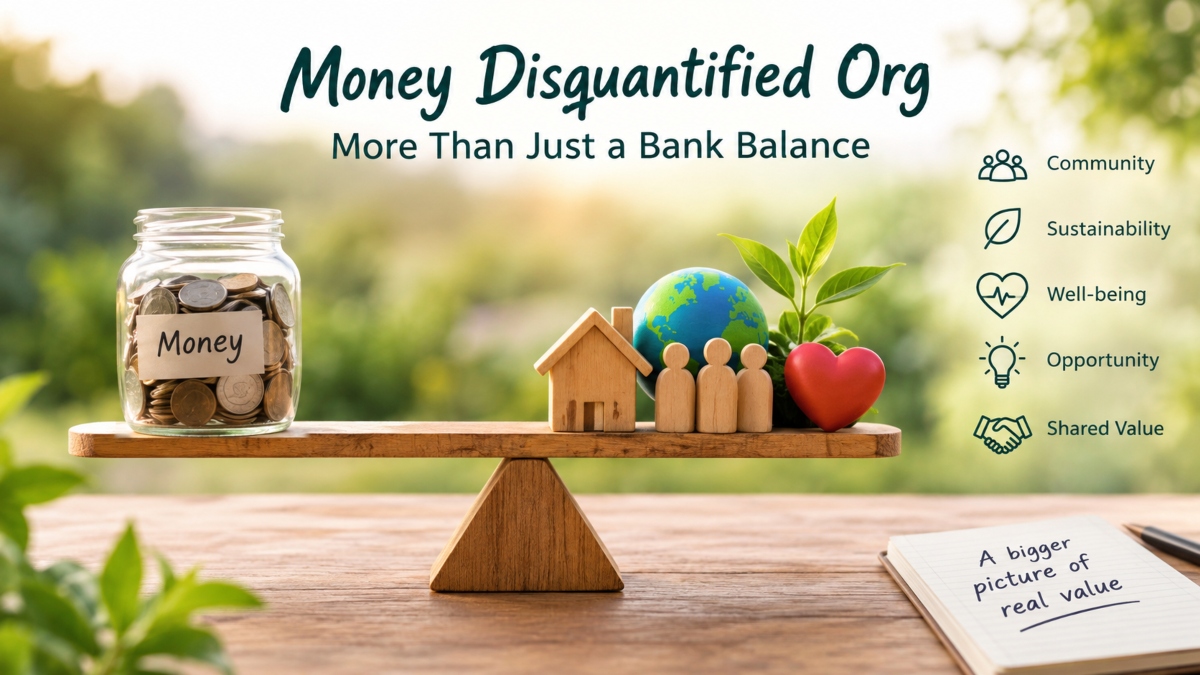
Money has a way of shaping how people judge success. A higher salary, a bigger savings account, or a more expensive home often looks like progress. But does money tell the whole story? Someone may earn well yet have little time for family, while another person may have fewer financial resources but enjoy strong relationships, good health, and a close community.
This is the idea behind Money Disquantified Org, a term linked to the concept of looking beyond financial figures when judging value. It encourages people to think about social connections, environmental care, personal freedom, and the quality of everyday life alongside money.
The term is also associated with Disquantified.org, a website that publishes content about this approach to money and value. Understanding the difference between the concept and the website helps readers make sense of what they are exploring.
What Is Money Disquantified Org?
Money Disquantified Org refers to an approach to money that questions whether income, price, and profit should be the only ways to measure value. Instead of looking at financial figures alone, this idea gives attention to the benefits that people, communities, and the environment receive from everyday choices.
Think about two products that serve the same purpose. One costs less but breaks after a few months. The other costs more, lasts for years, and can be repaired when something goes wrong. The cheaper option may look better at first, but the longer lasting product could offer better value over time.
The same thinking applies to services and relationships. Helping a neighbor, teaching someone a useful skill, or caring for a family member may not bring in money, yet these actions can make a real difference in someone’s life.
Money disquantification does not mean that money has no value. People still need it for food, housing, healthcare, education, and other basic needs. The idea is to recognize that financial worth and human worth are not the same thing.
The Meaning of Money Disquantification
Money disquantification means placing less weight on financial figures when judging the full value of something. It encourages people to look at usefulness, fairness, durability, social benefit, and environmental costs.
For example, a community garden may produce fresh food while giving neighbors a place to meet, share skills, and work together. Its value goes beyond the price of the vegetables it grows.
This way of thinking also changes how people view unpaid work. Caring for children, helping older relatives, or volunteering at a local organization can support families and communities even when no money changes hands.
How It Differs From Traditional Money Based Thinking
Traditional financial thinking often relies on figures such as income, profit, expenses, and market price. These measures are useful when managing a household budget or running a business, but they cannot describe every part of a person’s life.
A business might earn more by choosing cheaper materials, yet those materials may wear out quickly or create more waste. Another business may charge a fair price for durable products and provide better working conditions.
Money disquantification asks people to look at these wider effects before deciding what something is worth. Rather than ignoring financial measures, it treats them as one part of a larger picture.
How Does Money Disquantified Org Work?
The basic idea is simple: when making a decision, consider both its financial cost and its wider effects. This could mean looking at how long a product will last, how a purchase affects local workers, or whether an activity improves the quality of life in a community.
For individuals, this approach may influence shopping habits, work choices, and the way they spend their free time. For communities, it may encourage shared resources, local projects, and cooperation between people with different skills.
It is not a single payment system with one set of rules. It is better understood as a way of thinking about value that can be applied in different settings.
Looking Beyond Price and Profit
Price tells you how much money you need to pay. It does not always tell you how useful, reliable, or durable a product will be.
Imagine buying a low priced pair of shoes that needs replacing every few months. A better made pair might cost more at the start but remain comfortable for several years. Looking at the total cost over time gives you a clearer picture of the purchase.
Businesses can use similar thinking when choosing suppliers, materials, and working practices. A low purchase price may not be the best option if it brings higher repair costs, poor product quality, or unnecessary waste.
Recognizing Social and Environmental Value
Some benefits are difficult to express in money. A clean public park, a supportive neighborhood, or a community program for young people may improve many lives without producing a direct financial return.
Environmental choices also matter. Repairing an appliance instead of replacing it can save money and reduce waste. Sharing tools with neighbors can help people access items they need without everyone buying the same equipment.
These examples show how everyday decisions can create value that does not appear on a receipt or bank statement.
Core Principles of Money Disquantified
Money disquantification brings together several ideas about how people understand wealth, exchange resources, and make choices. Each principle offers a different way to look at value beyond a simple price tag.
Value Beyond Financial Measures
Financial figures remain useful, but they do not tell the whole story. A product’s quality, usefulness, safety, and expected lifespan can matter just as much when deciding whether it is worth buying.
The same applies to work. A job with a higher salary may not suit someone who has little time for family or faces constant stress. Another role with reasonable pay, better working hours, and a supportive environment may offer a better balance.
The right choice depends on a person’s needs and circumstances. The main point is to look at the full picture instead of allowing one number to make every decision.
Community Exchange and Shared Resources
Community exchange allows people to share goods, time, or skills without relying entirely on conventional purchases.
For example, a person who knows how to repair bicycles might help a neighbor in exchange for gardening support. A local sharing group might lend tools, cooking equipment, or other items that people only need occasionally.
Time banks follow a related idea. Members exchange services using time credits, so an hour of one person’s help can be exchanged for an hour of another person’s service.
These arrangements can strengthen local relationships and reduce some expenses. However, they work best when participants agree on clear rules and understand their responsibilities.
Environmental Responsibility
A product’s environmental cost may not appear in its retail price. Manufacturing, transport, packaging, and disposal can all affect the natural world.
Money disquantification encourages people to consider these factors when making purchasing decisions. Buying fewer disposable items, repairing useful products, and choosing durable goods can reduce waste.
This does not mean everyone must buy expensive eco friendly products. Budget limits are real, and people have different options available to them. Even small choices, such as reusing containers or passing on unwanted items, can support more thoughtful consumption.
Holistic Wealth and Personal Well Being
Wealth is often associated with money, property, and investments. These resources matter, but they are only part of what makes life comfortable and meaningful.
Health, knowledge, supportive relationships, free time, and personal independence also contribute to well being. Someone who has enough money to cover essential expenses and time to enjoy family life may feel more satisfied than someone who earns more but has no room for rest.
This is not a reason to dismiss financial goals. Savings can provide security, and a stable income can open doors to education and better living conditions. A broader view of wealth simply recognizes that money works best when it supports the life a person wants to live.
Potential Benefits of Money Disquantified Org
The appeal of money disquantification comes from its wider view of success. Rather than judging every choice by its immediate financial return, it encourages people to think about lasting benefits for themselves and others.
Stronger Local Relationships
When neighbors share skills, exchange resources, or take part in local projects, they have more chances to get to know one another. These connections can make it easier to ask for help, learn something new, or work through common problems.
A simple example is a neighborhood group where residents share gardening tools or help one another with small repairs. Members may save money, but they can also build trust through regular cooperation.
Such activities will not solve every community problem, yet they can give people practical ways to support one another.
More Thoughtful Spending Choices
A low price can be tempting, particularly when household expenses are rising. However, choosing the cheapest option every time may not be the best way to manage money.
Looking at quality, repair costs, expected lifespan, and actual needs can help people make more informed decisions. Buying an item that serves its purpose for years may be better than repeatedly replacing a cheaper alternative.
This approach can also help people avoid unnecessary purchases. Before spending money, they can ask whether an item will be useful, whether they already own something similar, and whether the purchase fits their budget.
A Wider View of Prosperity
Money disquantification encourages people to think about what they want their money to achieve. For one person, that might mean paying off debt. For another, it could mean spending more time with family, learning a skill, or supporting a local cause.
There is no single definition of a good life that fits everyone. The value of this approach lies in making room for personal goals alongside financial ones.
A healthy financial plan should support basic needs, future security, and personal priorities rather than focusing only on earning more.
Real World Examples of Money Disquantification
The idea becomes easier to understand when connected to activities that people already know. Several community practices show how value can be created through cooperation, resource sharing, and responsible use of goods.
Time Banks and Skill Sharing
A time bank allows members to exchange services using time credits. Someone might spend an hour helping a neighbor with computer basics and later use an hour of credit to receive help with gardening or home repairs.
The system values people’s time and skills without requiring every exchange to involve a direct cash payment.
Skill sharing can also happen informally. Friends may help each other learn a language, repair furniture, or prepare for a job interview. These exchanges create practical benefits even when no money changes hands.
Time banks do have limits. Participants need suitable services, reliable members, and clear arrangements for exchanging time.
Repair Cafés and Reuse Programs
Repair cafés bring people together to fix damaged household items, clothing, bicycles, and small appliances. Volunteers or skilled participants may help others learn how to repair things rather than throwing them away.
Consider a toaster with a minor fault. If it can be repaired safely, fixing it may cost less than buying a replacement and keep a useful item out of the waste stream.
Reuse programs work in a similar way. Donating furniture, exchanging books, or passing on children’s clothing can help another household while reducing unnecessary purchases.
These activities show how an item’s usefulness can extend beyond its original owner or selling price.
Community Supported Agriculture and Mutual Aid
Community supported agriculture connects consumers with local farms through arrangements that may involve advance payments, regular produce boxes, or shared support for a growing season.
Participants may gain access to local food while developing a closer connection with the people who grow it. Farmers may receive more predictable income, although results depend on the terms of the arrangement and the success of the harvest.
Mutual aid groups offer another example. Members may share food, transport, supplies, or practical help when someone needs support.
Both approaches rely on cooperation. They can complement ordinary markets, although they cannot replace every service or financial resource a community needs.
Limitations and Risks of Money Disquantified Org
Looking beyond money can help people make thoughtful decisions, but the approach also raises practical questions. Recognizing wider value is easier in theory than measuring it consistently or applying it across an entire economy.
The Difficulty of Measuring Non Monetary Value
Financial figures offer a common way to compare costs and income. Social and environmental benefits are harder to measure because people may disagree about their importance.
For example, one person may value a product’s long lifespan, while another may focus on its purchase price because their budget is limited. Both concerns are valid.
There is also a risk of making vague claims about social benefit without clear evidence. When an organization says that a product or service helps a community, readers should ask what that means and how the claim can be checked.
Money disquantification does not remove the need for careful judgment. It asks people to consider more factors, some of which may be difficult to compare directly.
Scalability, Access, and Regulation
A small group may find it easy to exchange services or share equipment. Running a similar system across a large population is more difficult because people have different needs, schedules, skills, and resources.
Access can also be uneven. Digital exchange platforms may not work well for people without reliable internet access or the time to participate. Some people may need cash for expenses that cannot be covered through shared services.
Legal responsibilities matter, too. Depending on the country and the type of arrangement, certain exchanges may raise questions about tax, liability, consumer rights, or financial regulation. Anyone organizing a formal system should check the rules that apply to their situation.
The Risk of Vague Claims
Terms such as ethical, sustainable, and community focused can sound reassuring, but they do not automatically prove that an organization acts responsibly.
A business may promote its social goals while providing little information about its practices. Without clear standards, independent checks, or evidence, readers may find it difficult to judge whether those claims are accurate.
The same caution applies to websites discussing money disquantification. Readers should check who created the content, what evidence supports its claims, and whether the information is current.
A balanced approach combines concern for social value with transparency and practical evidence.
What Is Disquantified.org, and Can You Trust It?
Disquantified.org is a website associated with the term Money Disquantified Org. Its article on the subject presents money disquantification as an alternative way to think about value, with attention to community exchange, sustainability, and well being.
The broader Disquantified content network is also described in third party coverage as a source of introductory personal finance material, including topics such as budgeting, saving, banking, credit, loans, insurance, and investing.
This distinction matters because an article about financial ideas is not the same as a service that provides regulated financial advice. Readers should not assume that a website is a bank, investment firm, or licensed advisory provider simply because it publishes money related content.
The Website’s Stated Purpose and Content
The website’s article introduces readers to the idea of judging value through more than income, profit, and price. Its wider finance content covers topics that may help beginners become familiar with common money management concepts.
When reading this material, pay attention to the difference between an explanation, an opinion, and a factual claim. A general article can introduce an idea, but claims about financial products, laws, or investment choices need stronger supporting evidence.
Readers should also remember that a site’s description of its own purpose reflects how it presents itself. Independent checks may be needed to confirm details about its authors, services, and professional credentials.
How to Assess Credibility Before Relying on Its Advice
Before relying on financial information from Disquantified.org or any similar website, take a few simple steps.
First, check whether the article names its author and explains their relevant experience. Look for supporting evidence, references to reliable material, and a clear publication or update date.
Next, review the website’s privacy policy, contact details, and information about its ownership where available. If the site discusses financial products, check important claims against the relevant provider or official regulator.
Be cautious about making financial decisions based on a single article. General educational content can help you understand a topic, but personal decisions about debt, investments, insurance, or taxes may require advice from a qualified professional.
Based on the supplied research, Money Disquantified Org is best understood as a concept discussed through a content website, not as a verified financial institution. Its current credentials and any regulated status should be checked independently before relying on specific advice.
How to Apply Money Disquantification in Everyday Life
You do not need to join a formal exchange group or change your entire approach to money to put these ideas into practice. Small choices can help you consider both financial costs and wider benefits.
Make Purchases Based on Lasting Value
Before buying something, consider its price, quality, lifespan, repair options, and usefulness. A higher price does not always mean better value, so compare products based on your actual needs and budget.
It can also help to wait before making nonessential purchases. Giving yourself time to think may prevent spending money on items you will rarely use.
Support Community Projects Where Practical
Sharing useful skills, volunteering, joining a local repair event, or donating items in good condition can support other people without requiring large expenses.
Choose activities that fit your time, abilities, and financial situation. Helping others should not mean neglecting your own needs or taking on costs you cannot afford.
Keep Financial Security in View
A wider view of wealth should include practical financial planning. Paying essential bills, building emergency savings when possible, managing debt, and preparing for future expenses remain important.
Money can provide stability, choices, and protection during difficult periods. The goal is not to treat money as unimportant, but to use it in ways that support both present needs and future well being.
Frequently Asked Questions About Money Disquantified Org
What Is Money Disquantified Org?
Money Disquantified Org is a term associated with the idea of looking beyond financial measures when judging value. It draws attention to social relationships, environmental care, community exchange, and personal well being. The phrase is also linked to Disquantified.org, a website that publishes content about the concept and wider money related topics.
What Does Money Disquantification Mean?
Money disquantification means considering more than price, income, or profit when deciding what something is worth. It includes factors such as usefulness, quality, time, social benefit, and environmental effects. It does not mean that money is useless or that financial planning should be ignored.
How Does Money Disquantified Org View Wealth?
This approach treats wealth as more than the amount of money a person owns. It also considers health, knowledge, relationships, time, independence, and the quality of the surrounding environment. Financial security remains important because it helps people meet essential needs and prepare for unexpected expenses.
Is Money Disquantified Org a Financial Service or an Educational Concept?
The term is associated with an idea about money and value, as well as content published on Disquantified.org. The supplied research does not establish it as a regulated financial service. Readers should check the website’s current details and credentials before relying on any financial guidance it publishes.
What Are the Benefits of Money Disquantification?
Possible benefits include more thoughtful spending, greater attention to product durability, stronger community relationships, less waste, and a wider view of personal success. The results depend on how people apply these ideas and the resources available to them. These benefits should not be treated as guaranteed outcomes.
What Are the Main Limitations of Money Disquantification?
The main limitations include difficulty measuring social value, challenges when expanding local exchange systems, unequal access to resources, and possible legal or tax responsibilities. Vague claims about ethical or sustainable practices can also make it harder to judge whether an organization is delivering real benefits.
Can Money Disquantification Work in Everyday Life?
Yes, people can apply the idea by repairing useful items, comparing long term costs, sharing resources, supporting suitable local projects, and considering how purchases affect others. These choices can complement ordinary financial planning. People should still protect their budgets and meet essential expenses.
Is Disquantified.org a Reliable Source of Financial Information?
Its content may serve as an introduction to money related topics, but readers should assess each article on its own merits. Check author credentials, supporting evidence, publication dates, and important claims against trusted sources. Do not assume that educational content is the same as personalized or regulated financial advice.
Final Thoughts
Money Disquantified Org raises a simple question: how much of life’s value can a bank balance actually show?
Money matters. It pays for housing, food, education, healthcare, and the choices that make daily life easier. Yet it cannot fully measure the value of a supportive friend, a healthy environment, a useful skill, or time spent with family.
The idea of money disquantification encourages people to consider these parts of life when making financial and personal decisions. It can offer a useful perspective on spending, community exchange, and sustainability, provided its limits are understood.
For readers exploring Disquantified.org, the sensible approach is to separate the website’s claims from the broader concept and check financial information before acting on it. A thoughtful view of wealth makes room for both financial security and the things that give life meaning.
Read More: Posts Blog#WizzyDigital.org: A Guide to Topics, Resources, and Digital Growth